How Rugby Kicks Trade Possession for Territory
Rugby kicks can contest possession, move play into touch or relieve pressure. Learn how to read the aim, the likely restart and the chase that follows.
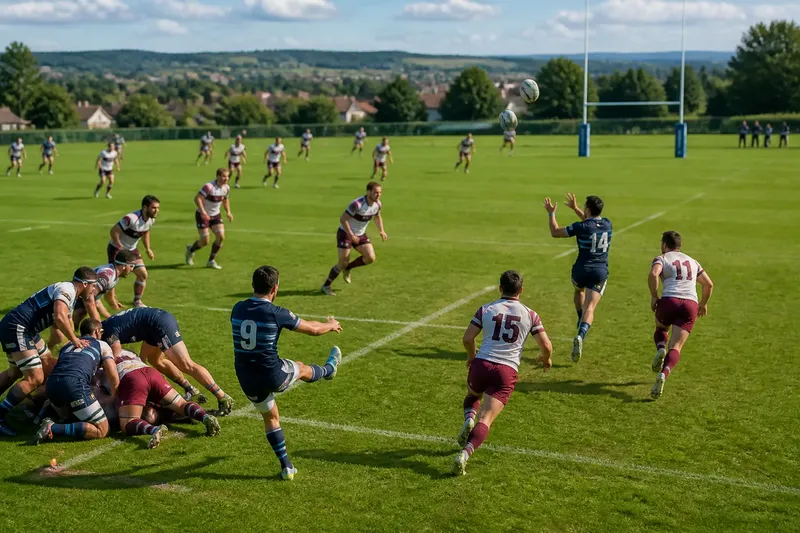
A rugby kick does not always hand the ball to the opposition. A high kick may invite a contest, while a kick into touch may exchange open-play possession for territory, subject to the laws and circumstances of the kick. Watch the target and the chase to see what the team is trying to gain.
Imagine a side defending just outside its own twenty-two, with the other team pressing upfield. Its scrum-half has the ball at the base of a ruck; one winger is advancing and the backfield is spread. The scrum-half has a choice between passing near the ruck, contesting space behind the winger or kicking for distance. Each choice creates a different next phase.
The starting picture
Before following the ball, note where the kick is taken, who is positioned to receive it and whether the chasers advance together. Those details help distinguish a bid for possession from a territorial exchange or an attempt to relieve pressure.
- Check the kicking position. If the team is near its own try line, then a clearance may be aimed at moving play away; if it is near the opposition try line, then a kick may instead be designed to exploit space behind the defence.
- Check the backfield. If a defender is set to catch, then expect a contest over the catch or pressure on the return; if the space is empty, then watch whether the kick makes defenders turn and retreat.
- Check the chase. If several players advance in a connected line, then the kick may be intended to apply pressure; if the chasers are distant, then the receiving side may have room to counterattack.
A plan can be sound and the execution poor. Rugby has no special procedure for making a tidy outcome appear merely because the intention was sensible.
A contestable kick
A contestable kick is sent high enough and towards a space where the kicking side can challenge for the ball as it descends. It offers a chance to regain possession, not a promise of one. The receiving side may catch cleanly, tap the ball onwards or mishandle it.
The chase matters. Kicking players must observe the offside law and cannot interfere with play while offside; the precise circumstances for becoming onside are governed by the laws. A coordinated chase can put pressure on the catcher, while an isolated chaser may leave the receiver time and space.
In the imagined opening, suppose the advancing winger catches the high ball but faces two arriving chasers and cannot make an easy pass. The receiving side still has possession, but its next action may be a carry into contact or a hurried kick. The kicking team has changed the conditions of that possession without winning the ball.
If the kicking team does recover the ball, it can turn defence into attack. If it does not, the kick may still have made the return harder. Those are different outcomes, and neither should be confused with the other.
A kick into touch
A kick aimed into touch can move play upfield, but the restart and possession outcome depend on the applicable laws and the circumstances of the kick. The position from which the ball is kicked, how it reaches touch and whether it has been carried back can matter. A blanket rule that the opposition always receives a lineout throw would be too simple.
In the imagined situation, the scrum-half could kick the ball into touch rather than send it high towards the winger. The team would stop open play and seek a more favourable position for the restart, but it would need to account for the relevant lineout rules. The tactical exchange is clear even when the exact restart requires closer attention to the laws.
Touch is not automatically a failed attempt to keep the ball. It can be an intentional trade: give up the chance to continue attacking in open play in order to change the field position and prepare for the next phase. A team near its own line may judge that exchange differently from a team near the opposition try line.
A clearance under pressure
A clearance is aimed chiefly at getting the ball away from a dangerous area and changing where the next contest begins. The receiver may collect it, but the kicking side can still have made the opponent turn, retreat or organise a return from farther away.
Distance alone does not tell you whether the kick helped. A long kick into space may invite a counterattack; a shorter kick with a connected chase may leave the receiver under pressure. Look at the backfield, the flight of the ball and the shape of the advancing players.
Imagine the scrum-half sees the opposition full-back moving towards the touchline and sends a low kick into open space behind. The full-back gathers it but must turn back towards support, while the kicking team advances in a connected line. The expected observable result is not necessarily a turnover: the receiving side may return the ball under pressure, while the defending side has moved the contest away from its own line. If the full-back instead has clear space and support, the same kick may invite a counterattack.
Reading the trade?
Does every kick hand over possession?
No. The kicking side may recover a loose ball or win a contest, while a kick into touch can produce a restart whose possession outcome depends on the laws and circumstances. The flight alone does not settle who gets the next possession.
What makes a kick contestable?
The kick gives teammates a chance to challenge for the ball as it descends. A connected chase can put the receiver under pressure; an unaccompanied high ball may simply give the catcher time.
Why kick while in possession?
A team may use a kick to make defenders retreat, move play away from danger or contest a ball in space. It gives up some options in open play in exchange for a different field position or a more difficult return.
How can I judge whether a kick worked?
Watch the next phase rather than only the first player to touch the ball. Consider whether the kick changed field position, created pressure or left the receiving side with room to counterattack.
A worked reading
Return to the invented opening with its stated starting details: the defending side is just outside its own twenty-two, the scrum-half is at a ruck, the winger is advancing and the backfield is spread. Suppose the scrum-half chooses a high kick into the space behind that winger. The winger catches it, two chasers arrive and the receiver carries into contact rather than passing cleanly. The observable result is that the opposition retains possession but begins its next phase under pressure; no turnover has occurred.
Change one starting detail: imagine the backfield is set beneath the kick and the chasers are too far away. The same high kick may then give the catcher time to choose a return, so the expected trade is less attractive. If the team instead kicks into touch, the likely aim is to relocate play, but the exact restart must be read under the applicable laws.
For a quick reading of a rugby kick, identify its target, its cost and the likely next phase. Then follow the chasers after the ball leaves the boot. Their spacing often reveals whether the plan is to compete, contain or escape pressure, even when the ball’s destination looks much the same.