The Lineout’s Changing Shape: From Simple Throw-In to Set Play
Read a rugby lineout by tracking the target, aerial contest and first action after the catch, so the set play becomes easier to follow from the touchline.
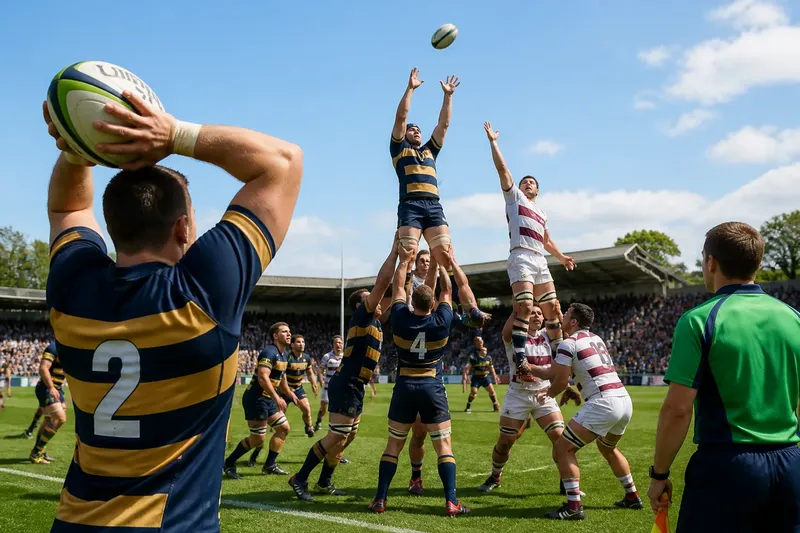
A rugby lineout is a set play, not merely a throw back into the field. Watch the target, the defensive response and the first action after the catch, and the crowd beside the touchline becomes a readable sequence of choices.
Restart and contest
When the ball goes into touch, play restarts with a throw between two lines of opposing players. The team entitled to throw organises its players; the opposition decides whether to challenge in the air or prepare for what follows.
The thrower has a target, a jumper can be lifted by teammates, and players near the landing point can form a maul or move the ball away. That structure gives a team a controlled moment to create an advantage.
Watch the arrangement before the ball’s flight. A quick throw, movement towards the front or a cluster near the back can each indicate a different plan, though none tells the whole story by itself.
Field position and choice
The location of the lineout shapes the decision. Near the opposition’s goal line, a team may seek a secure catch and a maul. Further away, it may prefer a clean catch followed by a pass to backs waiting in space. Personnel, the throw-in position and the defensive set-up all affect the choice.
- Near the goal line: If players bind around the catcher, expect a maul attempt; if they spread to receive a pass, watch the first receiver instead.
- Near halfway: If the backs are spread and a receiver waits behind the lineout, expect a quick release; if the forwards gather around the catcher, watch for a carry or maul.
- Under pressure: If the team uses a clear target and receiver, expect a simpler route to possession; if its movement becomes complicated, watch whether the throw can still reach the intended jumper.
- Against an aerial challenge: If the opposition commits a jumper, the throwing side may target another part of the line; if defenders stay grounded, watch whether the throw goes to a supported jumper.
- When a maul defence gathers: If the ball is released quickly, the attack may spread play; if the carrier stays bound with teammates, expect the group to drive.
- After a messy catch: If the referee signals a stoppage, follow that decision; if play continues, watch which side secures the loose ball before judging the next action.
These are possibilities, not fixed rules. A team may threaten a maul to draw defenders in, then pass away from it. The useful question is what the arrangement asks the defence to do.
Roles and movement
The hooker delivers the ball. Jumpers move to the chosen point, teammates lift them, and a scrum-half or other receiver waits to collect the ball once it is secured. The opposing line reads that movement and decides whether to contest or protect against the next action.
Movement before the throw can disguise the target. A jumper may shift position as the lifting pair adjusts around them. Timing matters: the jumper needs to meet the ball where teammates can support them, while the thrower must deliver it accurately.
After the catch, the ball can be passed out, carried down from the jumper or held at the front of a maul. A quick pass asks defenders to close space; a maul asks them to stop a moving group; carrying the ball down can create a direct attack around the lineout’s edge.
Say a team has a lineout near the opposition’s twenty-two. Its forwards group at the back, while its backs spread across the field. The jumper catches, the ball reaches the scrum-half, and a pass goes to the first receiver before defenders reorganise. The visible outcome is an attack beginning with the backs rather than a maul; the set-up offered a choice, not a promise of open ground.
Defensive responses
If the opposition commits a jumper to contest, the throwing team may target another part of the line or move the ball away quickly. If defenders remain on the ground, a well-timed lift can make the catch harder to challenge. If they gather to stop a maul, the ball may be released before the group drives, leaving them to cover a wider attack.
For the defending side, each choice has a trade-off. Challenging in the air may disrupt possession but leave fewer players ready for the maul or backs. Staying grounded preserves a defensive line, but gives the throwing team a better chance of a clean catch.
When a throw goes awry, the outcome depends on the laws and the situation. The ball may be contested, recovered by either side or lead to a stoppage. A messy landing alone does not establish a foul; watch the referee’s signal and the players’ response.
Questions during a lineout?
Why do teams lift a jumper?
Lifting helps a player reach the intended point and can make a clean catch easier. It also makes coordination visible: the lifters must support the jumper while the thrower delivers the ball.
Why does a lineout become a maul?
A maul lets the catching team bind around the ball-carrier and move forward as a group. Teams may choose it for a controlled advance, while the defence tries to halt the movement or force the ball out.
Why do teams throw to the back?
A back-of-lineout target can give the team room to pass towards its backs or build a maul from that position. It can also make the defence spread its attention, although a longer throw may give the opposition a chance to challenge.
What should I watch after the catch?
Follow the ball to the first receiver, not just the jumper. That shows whether the plan is a quick pass, a carry or a maul, and how the lineout shapes the next phase.
Reading the first action
It is not worth trying to decode every call or memorise a team’s signals from the stands. Those details are often private, and the throw itself may change the plan. Instead, identify the target area, note whether the defence contests, then watch the first action after possession is secured.
Read the lineout as linked decisions rather than a collection of tricks. The arrangement sets up a contest; the catch determines how the ball can be protected or moved. The first pass or bind then tells you which route the team has taken, even if the defence promptly makes it less tidy.