Flanker or Number Eight: Two Jobs at the Back of the Scrum
Flanker or number eight: see where each player packs in the scrum, when they may detach and how their first movements reveal the next phase.
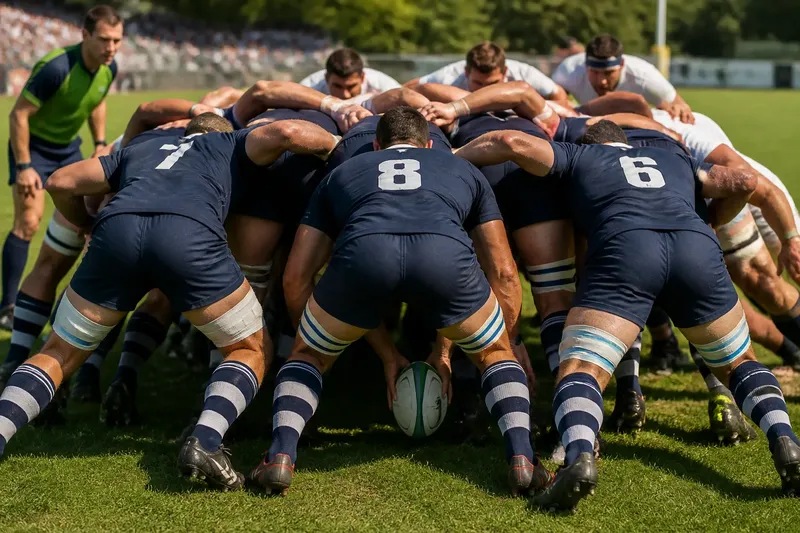
A flanker or number eight has a different place in the scrum and a different relationship to the ball. In a rugby scrum, the flankers bind on the outside of the two locks, while the number eight binds behind them at the rear; that arrangement helps explain who can reach the ball and who is poised to pressure the next phase.
Where they pack
Viewed from behind the scrum, the two locks form the second row, shoulder to shoulder. A flanker packs on each outside edge of that row, binding to a lock and to the front row according to the scrum’s required binding positions. The number eight packs behind the locks, between them, with the head and shoulders behind the second row. The eight is not another name for a flanker at the back corner.
“Openside” and “blindside” describe the flankers’ relationship to the space on either side of the scrum. The openside is generally on the side with more room; the blindside is on the tighter side. Which side that is depends on where the scrum is set and how the field is arranged, so the labels do not identify a permanent left or right position.
Rugby’s scrum laws require players to bind and keep their prescribed positions until the ball has left the scrum, subject to the applicable law and competition instructions. The precise binding requirements differ by position, and a player cannot simply detach to chase the ball while the scrum is still in progress. For a live decision about legality, use the current World Rugby laws and the relevant competition’s variations; the referee’s instruction takes precedence over a spectator’s confident guess.
The number eight’s choices
The number eight is positioned to control the ball at the scrum’s rear. Once the ball is available to be played, the eight can pick it up, or leave it for the scrum-half. The right choice depends on the team’s call, the ball’s position and the pressure around the base.
A pick-up can turn the scrum into a direct carry or a pass to a support runner. Leaving the ball gives the scrum-half the chance to pass it to the backs. The eight may then protect the base briefly or join the next phase, according to the play.
The useful question is not whether the eight carries, but what the defence is offering. A defender close to the base may make a quick pass more attractive; a defender pressing elsewhere may leave room for a carry. Neither choice is automatic.
The flankers’ first moves
While bound, the flankers contribute to the scrum’s drive and remain in their positions. Once the ball has left the scrum, they can move into their next jobs: pressing the opposing scrum-half or receiver, tracking a carrier, joining the attack as support, or folding into the defensive line.
The openside flanker is often expected to contest space quickly, but the name is a starting position, not a promise to reach every loose ball first. The blindside may cover a narrow channel or carry, while the openside presses elsewhere. Coaches can exchange those tasks, and the scrum’s location may shape the plan more than the role label.
Watch for the ball to leave before judging whether a flanker has detached at the right time. Moving too early can be penalised; moving late can leave the team without support in the next phase. The exact law application depends on the scrum situation and current competition rules, so avoid treating every early-looking movement as an offence from the stands.
Who carries from the scrum?
The number eight is a natural candidate because of the position at the rear, but the ball can be played by the scrum-half or passed to another player. A flanker can carry after receiving a pass or once play has developed. Shirt numbers alone do not identify the first carrier.
Say a team has a scrum near the middle of the pitch. In this invented situation, the ball reaches the rear cleanly, and the eight sees the opposing scrum-half step towards the base. The eight picks up and carries into the space that defender has left; the openside flanker moves alongside as support. The observable result is that the eight controls the first movement and the flanker is available for the next contact or pass.
Change one detail: imagine the scrum-half stays close to the base and the backs are set wide. The eight leaves the ball, and the scrum-half passes away from the scrum. That trades a direct carry for a quicker chance to attack the wider space. These are possible choices, not fixed outcomes.
A stable scrum gives the team a clearer platform for either option. If the ball is awkward or the pack is under pressure, the scrum-half may be better placed to play it promptly than the eight is to attempt a difficult pick-up. Do not spend much effort guessing the play from the eight’s posture alone; follow the ball as it emerges.
Reading the back row?
Does the number eight always pick up the ball?
No. The eight can carry or leave the ball for the scrum-half, depending on the team’s call and pressure at the base. Position gives the eight access, not an obligation to take possession.
Are openside and blindside flankers interchangeable?
They can have different assigned jobs, but the names refer to the sides of the scrum in relation to available space. The team’s plan and the field position determine who presses, covers or supports on a particular play.
When may a flanker detach?
A flanker must remain bound and in the required position while the scrum is in progress, then may move once the ball has left, subject to the current laws and any applicable competition variation. If the timing is unclear, check the law guidance for that competition rather than relying on a general description.
Why does the number eight stay near the scrum?
The eight may be preparing to pick up the ball, protecting the base or following the team’s planned move. Staying close can be more useful than joining the backs before the ball has been played.
What to watch
- Check the scrum’s shape: If the pack remains stable, expect the eight to have a clearer choice; if it is disrupted, watch for a prompt release to the scrum-half instead.
- Check where the ball reaches the rear: If it is cleanly placed for the eight, a pick-up is available; if it is awkward or still moving, look for the scrum-half to take it when playable.
- Check the eight’s hands: If the eight gathers the ball, follow the carry or pass; if the eight leaves it, follow the scrum-half’s delivery.
- Check which side has more open space: If one side is less crowded, watch the flanker there for pressure or support; if both sides are compact, track the players into the next defensive line.
- Check when the ball leaves the scrum: If it is still in the scrum, the flankers remain bound; if it has left, watch their first movement into the next job.
- Check the opposing scrum-half’s position: If that player moves towards the base, look for the eight to exploit the space left behind or the scrum-half to pass quickly; if the defender holds wide, watch for a different route.
- Check where each back-row player goes next: If the eight carries, track the flankers as support; if the scrum-half releases the ball, see which flanker presses and which folds into defence.
Choosing who to follow
Follow the number eight to see who controls the ball at the rear. Follow the flankers to see how the team pressures space beside the scrum and supports the next phase. A useful sequence is simple: locate the ball, identify who plays it, then track each flanker’s first move.
There is little value in memorising “the eight always carries” or “the openside always tackles first”. Both shortcuts ignore the ball, the defensive shape and the team’s call. The more dependable reading is to watch where each player starts and what changes once the ball leaves the scrum.
For the flanker or number eight, that starting position explains the first available job: the eight begins behind the locks with access to the ball, while the flankers begin on the outer edges and shape pressure or support. Follow the ball’s release as well as those positions, and the next phase becomes easier to read without pretending the shirt number dictates the play.