Why the Ball Goes Back After a Knock-On
Why the ball goes back after a knock-on: see how the ball’s direction determines the call, where the scrum is set and which side receives the feed.
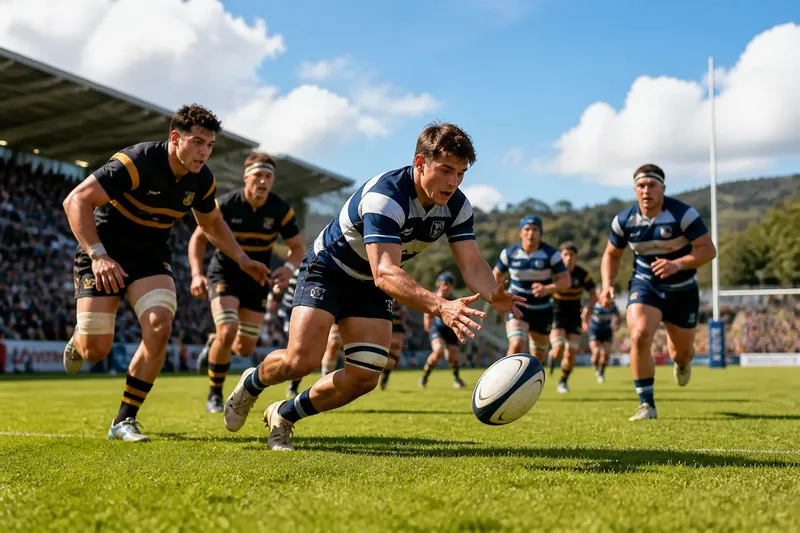
The ball goes back after a knock-on because rugby treats an accidental forward loss differently from a legal pass. The opposition will usually receive a scrum near the place of the knock-on, unless advantage or a special in-goal ruling changes the restart.
Ball direction
A knock-on occurs when a player loses possession and the ball travels forward, then touches the ground or another player before that player regains it. Direction is judged relative to the player’s movement and the ball’s movement at the moment of contact, not simply by whether it appears to travel towards the opponents’ goal line on television. A runner moving towards the goal line can let the ball slip backwards from the hands and still avoid a knock-on.
A forward pass is a separate offence. A pass is deliberately released from the hands; if it travels forward, it is a forward pass rather than a knock-on. Both can result in a scrum to the other team, but the referee is judging different actions: an intentional transfer in the first case, an accidental loss in the second.
Why play resets
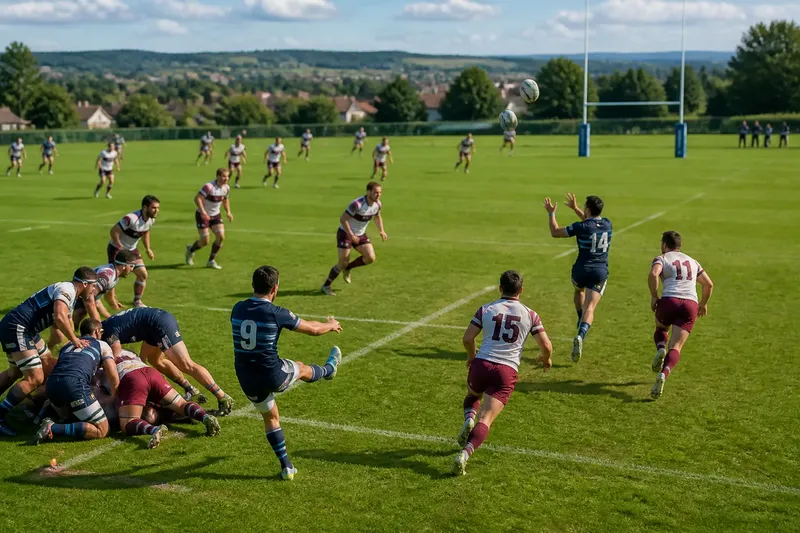
Players may run forward with the ball, but they cannot pass it forward. Teammates therefore need to support from behind, or the carrier can use a kick to send the ball ahead. Treating an accidental forward loss as ordinary progress would blur the distinction between carrying the ball and transferring it forward by hand.
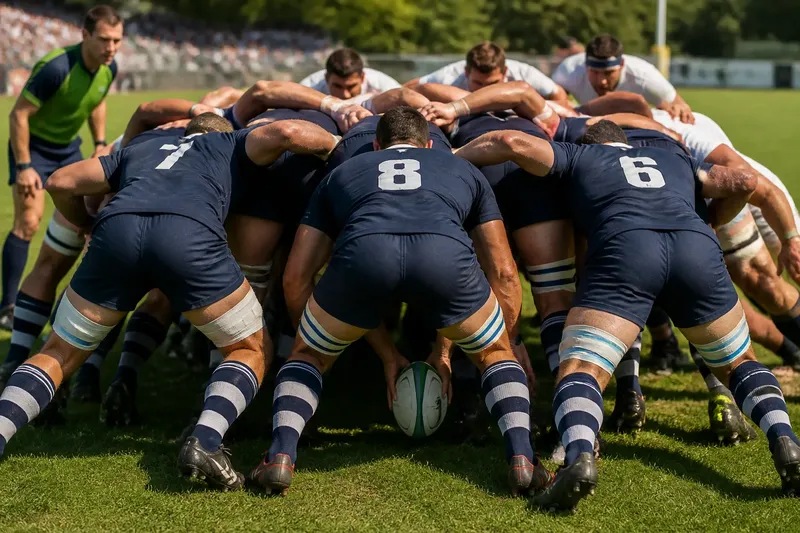
After a knock-on, the opposition will generally receive a scrum feed. That gives both teams a structured contest for possession instead of awarding the loose ball automatically to whoever is nearest. The scrum is usually set near where the knock-on occurred, subject to the specific law and circumstances.
How play resumes
Once the referee awards a scrum, the teams organise on opposite sides and the awarded team’s scrum-half feeds the ball. The scrum is a contest; the side with the feed still has to win possession and make use of it. The knock-on changes the restart, not the eventual outcome of the next attack.
Say a centre tries to gather a bouncing pass, loses it forward, and the ball hits the turf before anyone catches it. The referee awards the opposition a scrum near the fumble, and that side gets the feed. It still has to win the ball before building an attack.
Knock-on questions?
Does the ball have to hit the ground?
No. The ball can touch another player after travelling forward from the player’s hands; the ground is not essential to the definition.
Can the player regain their own knock-on?
Under World Rugby’s knock-on law, if the player regains the ball before it touches the ground or another player, play continues. If the ball has already touched the ground or another player, the knock-on has occurred; any advantage or other relevant law may still affect what happens next.
Why does the opposition get the scrum?
The scrum gives the non-offending team a structured contest after the forward loss interrupted play. It recognises the infringement without simply handing possession to the nearest player.
Does a knock-on always stop play at once?
No. The referee may play advantage if the other team can gain a useful benefit by continuing. If no advantage develops, the referee can return to the infringement and award the appropriate restart.
When calls differ
Not every forward contact is a knock-on. A ball rebounding forward from a player’s arm or body after an opponent’s kick, pass or knock-on is not automatically treated as one; the referee considers how the contact occurred, including whether the player was trying to catch or gather the ball.
A knock-on in the in-goal area can lead to a different restart from the ordinary scrum. Competition rules and the current law wording also matter in edge cases, so consult the applicable law book or a qualified referee when the exact ruling matters.
- Observe that the ball leaves the hands accidentally and travels forward; if it then touches the ground or another player before the original player regains it, expect a knock-on and usually an opposition scrum, otherwise consider whether it was a backward loss or a forward pass.
- Observe that the player deliberately releases the ball forward; if so, treat it as a forward pass and expect the corresponding restart, otherwise assess whether the release was accidental.
- Observe whether the original player regains the ball before it touches the ground or another player; if so, play continues under the knock-on law, otherwise the knock-on is complete.
- Observe whether the ball rebounds from an arm or body after an opponent’s action; if so, do not assume a knock-on and consider the nature of the contact, otherwise apply the ordinary knock-on test.
- Observe whether the referee signals advantage; if the other team gains a useful benefit, play may continue, otherwise expect the referee to return to the infringement and award a restart.
- Observe whether the knock-on occurs in the in-goal area; if so, check the applicable in-goal law for the restart, otherwise expect the ordinary knock-on outcome to apply.
Read the restart
After the whistle, note where the ball was lost, how it travelled from the player and which team receives the scrum feed. These details explain the decision more reliably than the apparent direction of the attack. Why the ball goes back after a knock-on comes down to the distinction between an accidental forward loss and a legal backward release.
It is not worth trying to judge every close call from a distant camera angle. A replay can hide the player’s movement or the first contact. For a spectator, watching the referee’s signal and the resulting scrum location usually tells you more about the next phase.